How fat loss works
On this page
You lose fat when you burn more energy than you eat for weeks, so your body draws on what it has stored. Most of that fat leaves as carbon dioxide you breathe out. Hormones change how hungry you are, not the arithmetic.
What we’d do
Stop thinking about burning fat in a single workout or a single meal, and think about the balance over a month. Pick a deficit you can hold without being hungry. Expect the scale to drop fast in the first week and slower after that, and re-check your calories every 10 to 15 pounds, because a smaller body needs less.
If you remember three things
- Fat loss is a monthly balance. One meal or one workout barely moves it.
- The first few pounds are mostly water. Your body stores its quick fuel with three to four times its weight in water, so it comes and goes fast.
- Loss slows as you get lighter. A smaller body burns less, so the same food becomes a smaller deficit.
Where does fat go when you lose it?
Ask people where lost fat goes and most will guess it turns into heat or energy. When two scientists at UNSW Sydney asked 150 doctors, dietitians and personal trainers, more than half said exactly that. In 2014 the two, the physicist Ruben Meerman and the biochemist Andrew Brown, worked it out atom by atom and published it in the BMJ. To burn 10 kg of fat, your body takes in 29 kg of oxygen and gives off 28 kg of carbon dioxide and 11 kg of water.
Counted by the fat’s own atoms, 84% of it leaves as carbon dioxide and 16% as water. If you lose 10 pounds of fat, about 8.4 pounds of it goes out through your lungs. The rest becomes water, which leaves in urine, sweat, breath and tears.
Your lungs are the main exit, but breathing harder won’t speed it up. Meerman and Brown point out that breathing faster without burning more fuel just leads to hyperventilation, which can make you dizzy or even faint. The only way to send more carbon out is to burn more than you take in, and that’s set by what you eat and how much you move. Sweating more doesn’t burn more fat either (more on sweat).
Where your body keeps its energy
Think of your body’s energy as money. Some of it is in your hand, some in your wallet, and most of it in savings.
- Blood sugar is the cash in your hand. It’s a small amount, always being spent and topped up.
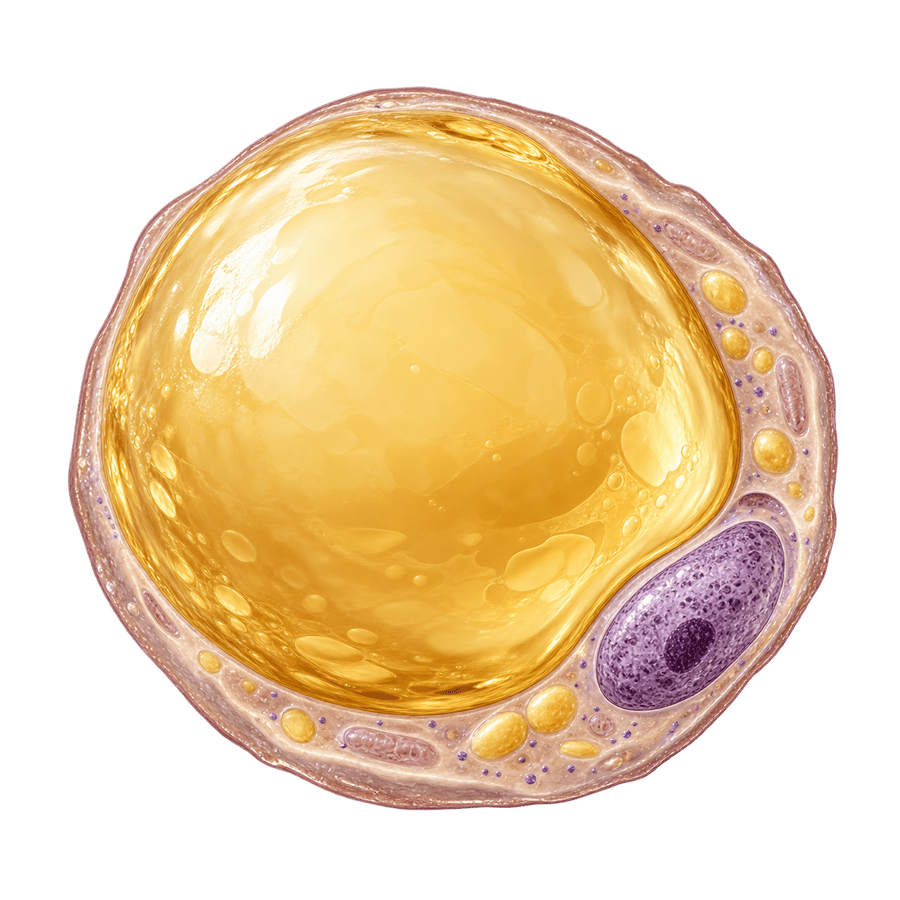
- Glycogen is your wallet. It’s sugar stored in your liver and muscles, about a day of fuel. Each gram is stored with three to four grams of water, which is why it shows up on the scale.
- Bodyfat is your savings account. It holds weeks of energy. The old rule of thumb is about 3,500 calories in a pound of bodyfat, so 30 pounds of fat holds around 105,000 calories, almost two months of food for someone who eats 2,000 a day.
- Muscle isn’t a store. Your body will break some down when food is short, more so when protein is low and you don’t lift. That’s the part of weight loss you want to avoid.
You don’t choose which account you spend from. The mix shifts through the day and with how hard you’re moving, and what decides your fat is the balance across all of them, week after week.
Does it matter if you burn fat or carbs?
Is paying from your wallet different from paying with a credit card? Sort of, but not really. The money comes out of a different place first, and it all comes out of the same account by the end of the month.
Burning fat works the same way. A low carb day burns more fat than a high carb one, and in the NIH ward study below, cutting carbs raised fat burning within days. But your body refills whatever it spent from wherever the next food arrives, so the share burned in one session doesn’t decide where you end up. In one small trial, 20 young women did an hour of cardio three times a week for four weeks, either fasted or after a small meal, on the same diet. Both groups lost weight and fat, and the difference between them was too small to count. There’s more on the fat-burning zone.
Is it calories or hormones?
The hormone side says
Insulin stores fat. Carbohydrates raise insulin, insulin tells fat cells to hold on, so cutting carbs should lose more fat even if calories stay the same.
Calorie counting fails most people. Millions have tried eating less and moving more, and most of them gained the weight back.
The trials say
Calorie for calorie, cutting carbs didn’t win. In 2015 NIH researchers kept 19 adults with obesity on a locked ward and cut their food by 30%, about 800 calories a day, once by cutting carbs and once by cutting fat. Cutting carbs lowered insulin as predicted. By the researchers’ fat balance measure, cutting fat lost more bodyfat, about 89 g a day against 53, and the body scans found no difference between the two.
Over a year it came out even. In the Stanford DIETFITS trial, 609 adults lost about 12 pounds on healthy low fat and 13 on healthy low carb. How much insulin each person made didn’t predict which diet suited them.
But hormones decide how much you eat. The same NIH group later fed 20 adults ultra-processed or unprocessed food for two weeks each and let them eat as much as they liked. On the ultra-processed food they ate about 500 calories a day more and gained about 2 pounds. On the unprocessed food they lost about 2.
Both sides have a point. The calories set the result. The food you choose, your sleep and your stress set your hunger, and your hunger sets the calories. That’s why losing fat starts with eating less without being hungry. There’s more on insulin and fat storage.
Why does weight loss slow down?
The 3,500 calorie rule says a deficit of 500 calories a day takes off a pound a week, every week, forever. It’s right about the first few weeks and wrong about the rest.
In 2013 a group of researchers checked the rule against seven weight loss studies where people lived in a research unit and every meal was measured, 103 adults in all. The rule predicted they would lose about 28 pounds. They lost about 20.
The rule misses two things. A lighter body burns less, so the same food becomes a smaller deficit as you go. And the body makes up some of the gap on its own, which is the subject of why your burn drops.
Kevin Hall’s team at the NIH built a model of this from the experiments. Their rule of thumb is that every change of 10 calories a day changes your weight by about a pound in the end. Half of that change comes in about a year, and 95% in about three years. Cut 250 calories a day for good and you’ll end up about 25 pounds lighter, not 26 pounds lighter every year.
| What you change for good | Where your weight ends up | How long it takes |
|---|---|---|
| 100 calories a day less | About 10 pounds lighter | Half in a year, most of it by three |
| 250 calories a day less | About 25 pounds lighter | Half in a year, most of it by three |
| 500 calories a day less | About 50 pounds lighter | Half in a year, most of it by three |
That table explains the most common plateau. Your calories haven’t stopped working. You’ve arrived near the weight those calories support, and to keep going you need a new number. Your calories, pace and protein covers how to set and re-set it.
Why is the first week so fast?
In the first week of a diet the scale often drops fast, and people think they’ve found the answer. A lot of that is glycogen and the water stored with it. You eat less, you run your wallet down, and the water leaves with it. It comes back just as fast when you eat more carbs again, which is why one big dinner can put pounds back on the scale overnight.
None of that is fat. Fat changes slowly, and it takes about three or four weeks of trend before the scale shows it. Tracking your food and your weight explains how to see through the swings.
Why lose fat at all?
Most people start for how they look, and the health gains are bigger than the mirror shows.
- Where it sits counts. The NIH’s heart and lung institute says a waist over 40 inches for men or 35 for women raises your risk of heart disease and type 2 diabetes, and that fat around the waist is riskier than fat at the hips.
- A small loss does a lot. In the Diabetes Prevention Program, 3,234 US adults with raised blood sugar were coached to lose 7% of their weight and walk 150 minutes a week. Over about three years they got type 2 diabetes 58% less often than the placebo group.
- It’s the American normal now. In the latest national survey, 2021 to 2023, 40.3% of US adults had obesity and 9.4% had severe obesity.
12 sources
- Meerman and Brown, When somebody loses weight, where does the fat go?, BMJ, 2014pubmed.ncbi.nlm.nih.gov
- UNSW Sydney, When we lose weight, where does the fat go?, 2014unsw.edu.au
- Kreitzman, Coxon and Szaz, Glycogen storage: illusions of easy weight loss, excessive weight regain, and distortions in estimates of body composition, American Journal of Clinical Nutrition, 1992pubmed.ncbi.nlm.nih.gov
- Thomas et al., Can a weight loss of one pound a week be achieved with a 3500-kcal deficit? Commentary on a commonly accepted rule, International Journal of Obesity, 2013pmc.ncbi.nlm.nih.gov
- Hall et al., Quantification of the effect of energy imbalance on bodyweight, The Lancet, 2011pmc.ncbi.nlm.nih.gov
- Hall et al., metabolic ward trial of cutting fat against cutting carbohydrate in people with obesity (Calorie for calorie, dietary fat restriction...), Cell Metabolism, 2015pmc.ncbi.nlm.nih.gov
- Gardner et al., Effect of low-fat vs low-carbohydrate diet on 12-month weight loss (DIETFITS), JAMA, 2018pmc.ncbi.nlm.nih.gov
- Hall et al., Ultra-processed diets cause excess calorie intake and weight gain: an inpatient randomized controlled trial of ad libitum food intake, Cell Metabolism, 2019pubmed.ncbi.nlm.nih.gov
- Schoenfeld et al., Body composition changes associated with fasted versus non-fasted aerobic exercise, Journal of the International Society of Sports Nutrition, 2014pubmed.ncbi.nlm.nih.gov
- NHLBI, Aim for a healthy weight, 2025nhlbi.nih.gov
- Knowler et al. (Diabetes Prevention Program Research Group), Reduction in the incidence of type 2 diabetes with lifestyle intervention or metformin, NEJM, 2002pubmed.ncbi.nlm.nih.gov
- Emmerich et al., Obesity and severe obesity prevalence in adults: United States, August 2021 to August 2023, NCHS Data Brief 508, CDC, 2024cdc.gov