Everything you need to know about fat loss
On this page
You lose fat by eating a little less than you burn, for months. The hard part is holding that gap without being hungry or losing muscle. Protein, whole food, lifting, sleep and a daily weigh-in do most of the work.
What we’d do
Start with your food, not the gym. Eat protein at every meal, swap packaged food and sweet drinks for whole food, and aim to lose about 1 to 2 pounds a week. Lift weights at least two days a week and walk every day. Weigh yourself every morning and judge the trend over a month, along with your waist.
When you reach your goal, plan the second half the same way. Most of the weight people lose comes back within five years, and the habits that stop it are on keeping it off.
If you remember three things
- Hunger decides whether a diet lasts. Pick foods that keep you full on fewer calories, like protein, fiber and food that still looks like it grew or walked.
- Go about 0.5 to 1 percent of your weight a week. For most people that’s 1 to 2 pounds. Faster costs more muscle.
- Your weight swings by pounds from day to day. Judge it by the trend over weeks, never by one morning.
Why does fat loss advice disagree so much?
Most people who want to lose fat have tried before, and the advice they found splits into two camps. One says it’s only calories in and calories out, so eat less and move more. The other says calories barely count, and a hormone, usually insulin, decides whether food gets stored as fat. Both camps point to studies, and both are partly right.
Calories decide whether you lose fat. Your hormones, your sleep and the food you pick decide how hungry you are while you do it, and hunger decides whether you keep going.
Stanford researchers tested the two camps head to head. They put 609 adults on a healthy low fat diet or a healthy low carb diet for a year. Both groups were told to eat whole food and cut sugar and refined flour. The low fat group lost about 12 pounds (5.3 kg) and the low carb group about 13 (6.0 kg), and the gap was too small to be sure of. The researchers also tested genes and how much insulin each person made, and neither predicted who would do better on which diet.
Pick the way of eating you can keep, since both worked about equally well.
The whole thing in one picture
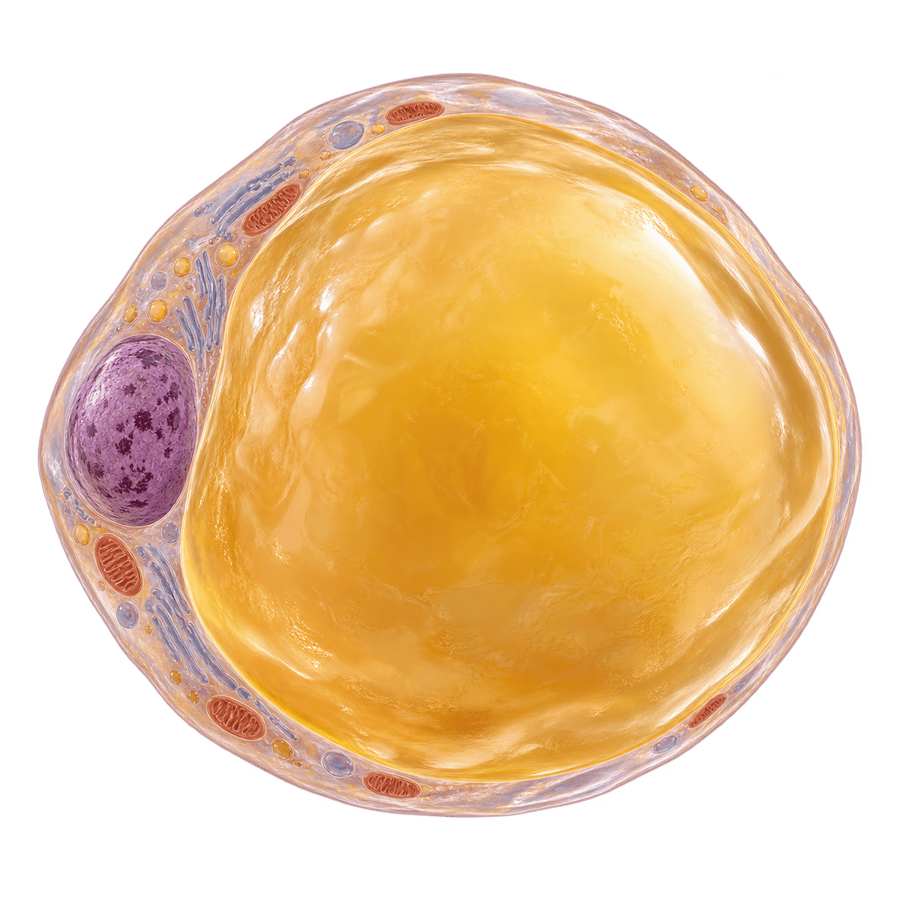
Think of your body’s energy as money. The sugar in your blood is the cash in your hand. The glycogen in your liver and muscles is your wallet, a day or so of spending. Your bodyfat is your savings account, enough for weeks.
Every day you get paid (you eat) and you spend (you burn). Some days you pay from your wallet and some days from your savings. At the end of the month the only question is whether the total went up or down. That’s why it makes little difference whether a workout burned “fat” or “carbs”. You can pay for lunch from your wallet and still save money that month.
When you lose fat, it doesn’t go anywhere mysterious. If you lose 10 pounds of fat, about 8.4 pounds leave your body as carbon dioxide you breathe out, and the other 1.6 pounds as water.
The six parts of the guide
- How fat loss works. Where your energy is stored, where fat goes when you lose it, and why loss slows down as you go.
- Your calories, pace and protein. How to set your three numbers, and when to change them.
- How to eat less without being hungry. Protein, fiber, whole food, drinks and sleep, the same dials GLP-1 drugs turn.
- Lifting, walking and cardio. Why a workout burns less than your watch says, and why you should lift anyway.
- Tracking your food and your weight. How to weigh in, what the swings mean, and how far off a bodyfat scale can be.
- Why you’re not losing weight. The mistakes that stall fat loss, and how to spot yours.
The numbers in one table
| What we’d aim for | Why | |
|---|---|---|
| Pace | 0.5 to 1% of your weight a week, about 1 to 2 pounds | Elite athletes who lost 0.7% a week gained lean mass. Those who aimed for 1.4% didn’t. The CDC says people who lose 1 to 2 pounds a week are more likely to keep it off |
| Deficit | About 500 to 1,000 calories a day under your maintenance at the start | A pound of fat holds about 3,500 calories. The gap shrinks as you get lighter, so you re-check it |
| Calorie floor | Not under about 1,200 a day for women or 1,500 for men without a doctor | Those are the low ends of the ranges in the 2013 US obesity guideline |
| Protein | 1.2 to 1.6 g per kg of body weight a day (about 100 to 130 g at 180 pounds), spread over your meals. Under it is too low | It keeps you full and protects muscle. Find your range |
| Lifting | 2 days a week or more | The US activity guidelines ask for at least 2 days of muscle work. It’s how you keep muscle while you lose fat |
| Walking | Every day, and 150 minutes of brisk activity a week | The same guidelines. Daily steps also keep your burn from sliding as you lose |
| Sleep | 7 hours or more | The CDC’s number for adults. Short sleep makes you hungrier |
| Weigh-in | Every morning, judged over 2 to 4 weeks | In one trial, people asked to weigh daily lost 6.6% of their weight in 6 months, against almost none in the group that waited |
What the drugs taught everyone
In the STEP 1 trial, 1,961 adults on weekly semaglutide (Wegovy) lost 14.9% of their weight over 68 weeks, against 2.4% on placebo. The drug doesn’t burn fat. It turns hunger down, so people eat less without fighting it.
Two things from those trials apply to everyone. Hunger is the main thing that decides how much you eat. And in the body scans from the tirzepatide (Zepbound) trial, about a quarter of the weight people lost was lean mass, on the drug and on placebo alike. Protein and lifting are how you keep that share small. There’s more on how GLP-1 drugs work.
Why exercise is part two, not part one
Your body makes up for some of what a workout burns. In a 2021 study of 1,754 adults, on average only 72% of the calories burned in activity showed up as extra calories burned that day. People with more bodyfat made up for more. Lifting and walking are still in the plan, because they protect your muscle, your heart and your blood sugar. But food is where most of the deficit comes from. The details are in lifting, walking and cardio.
After the diet
Losing the weight is the part most people manage. In a 2001 review of 29 US weight loss studies, people had kept off about a quarter of what they lost after four or five years. The second guide covers the first months after a diet, your new maintenance calories, why your daily burn drops, diet breaks and bulking after a cut.
13 sources
- Gardner et al., Effect of low-fat vs low-carbohydrate diet on 12-month weight loss in overweight adults and the association with genotype pattern or insulin secretion (DIETFITS), JAMA, 2018pmc.ncbi.nlm.nih.gov
- Meerman and Brown, When somebody loses weight, where does the fat go?, BMJ, 2014pubmed.ncbi.nlm.nih.gov
- Hall et al., Quantification of the effect of energy imbalance on bodyweight, The Lancet, 2011pmc.ncbi.nlm.nih.gov
- Garthe et al., Effect of two different weight-loss rates on body composition and strength and power-related performance in elite athletes, International Journal of Sport Nutrition and Exercise Metabolism, 2011pubmed.ncbi.nlm.nih.gov
- CDC, Steps for losing weight, 2025cdc.gov
- Jensen et al., 2013 AHA/ACC/TOS guideline for the management of overweight and obesity in adults, Circulationpmc.ncbi.nlm.nih.gov
- Wilding et al., Once-weekly semaglutide in adults with overweight or obesity (STEP 1), NEJM, 2021pubmed.ncbi.nlm.nih.gov
- Look et al., Body composition changes during weight reduction with tirzepatide in the SURMOUNT-1 study, Diabetes, Obesity and Metabolism, 2025pubmed.ncbi.nlm.nih.gov
- Careau et al., Energy compensation and adiposity in humans, Current Biology, 2021pubmed.ncbi.nlm.nih.gov
- CDC, Adult activity: an overviewcdc.gov
- CDC, About sleepcdc.gov
- Steinberg et al., The efficacy of a daily self-weighing weight loss intervention using smart scales and e-mail, Obesity, 2013pubmed.ncbi.nlm.nih.gov
- Anderson et al., Long-term weight-loss maintenance: a meta-analysis of US studies, American Journal of Clinical Nutrition, 2001pubmed.ncbi.nlm.nih.gov